






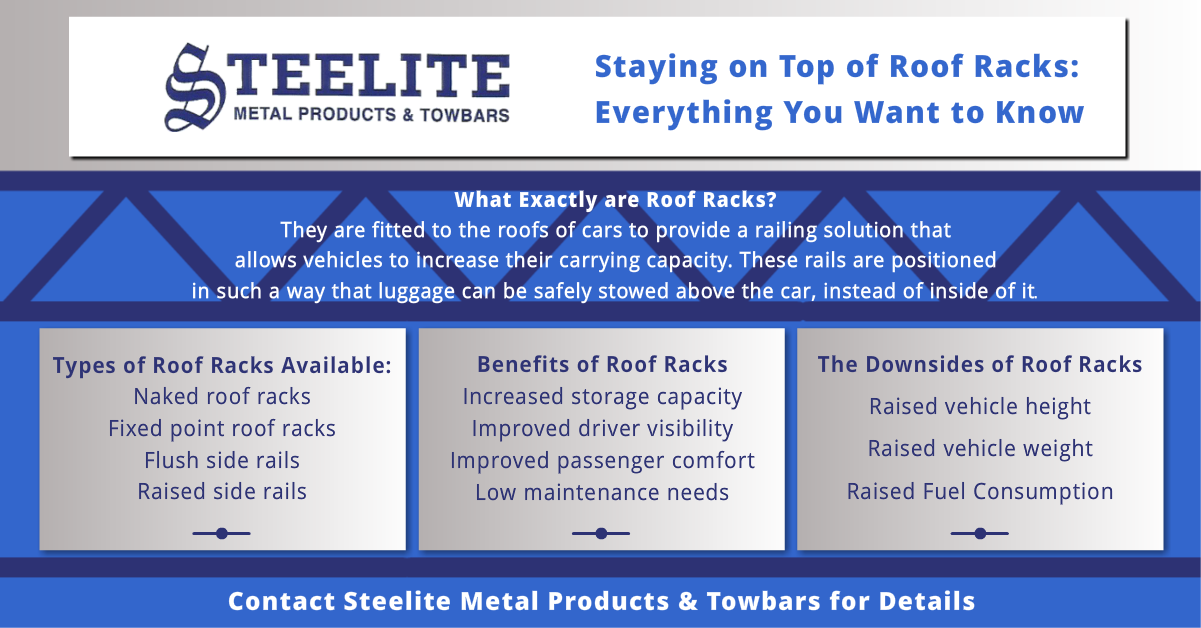
Staying on Top of Roof Racks: Everything You Want to Know
Roof racks are nothing new or special to the automotive industry, with more and more cars benefitting from the features they add to vehicles each day.
They are the perfect solution for those looking to increase the load capacity of their vehicle, enhance on-road safety and provide a more comfortable experience for their passengers.
There are a number of excellent reasons to consider getting one, which may lead you to a few more important questions that will help you make the best possible choice when you do; so that you can get the most use out of them.
Here we will explore a few details about them, starting with an overview of what they are and how they work, moving through to their many benefits and their few disadvantages that you should be aware of when using them, as well as your choices between materials when looking for custom roof racks for your vehicle.
There is a lot of ground to cover here, so let’s get started by taking a look at what they are exactly, and how they are used:
What Exactly are Roof Racks?
The question might seem like a silly one at first glance, we do, after all, see roof racks every day on the roads around us.
They have become a commonplace part of our daily lives, but what do you really know about them?
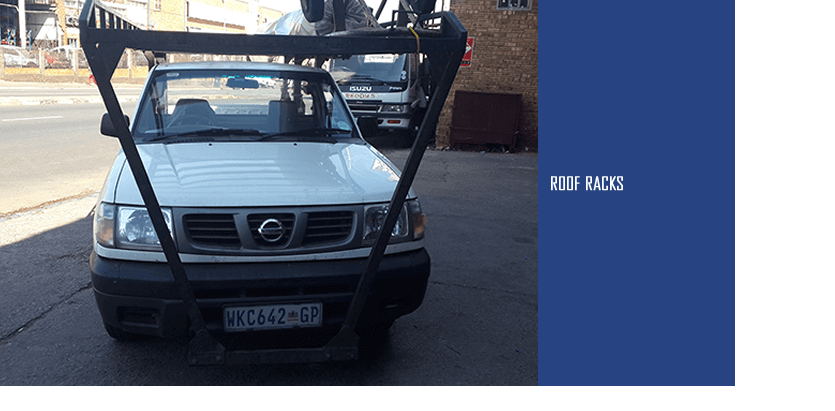
They are fitted to the roofs of cars to provide a railing solution that allows vehicles to increase their carrying capacity.
These rails are positioned in such a way that luggage can be safely stowed above the car, instead of inside of it.
With that simple explanation out of the way, you might not know that there are a great many different types of rails you can put on your vehicle.
The type you choose will depend on what you need to carry, what type of vehicle you have, and also the aesthetics you would like your car to have.
All in all, there are seven different types of roof racks, you can look at getting for your vehicle, each with slight differences in terms of their features.
Here we will discuss the most common of these, namely naked rails, fixed point rails, flush side rails and raised side rails:
Naked Roof Racks
These types of rails are most commonly found on sedans and offer a fairly discreet solution. Typically, they are identified by the fact that they are situated atop an empty vehicle roof, and have no discernible attachment points.
Fixed Point Roof Racks
Fixed point racks also offer something discreet by covering their attachment points with either a cover or a plastic door. These attachment points can be identified in fixed positions, and are typically used to support flush rails or raised rails.
Flush Side Rails
Flush side rails provide very little space between the roof of the car and the rails themselves. Each rail in these setups run parallel to the doors of the car to create a pair of rails that blend seamlessly with the roof of the car.
Raised Side Rails
Raised side rails take on the same orientation of flush side rails, except that they have more space between them and the roof of the car, since they are slightly raised.
There are, of course, many other types of roof racks that you can take advantage of, including gutters, tracks and crossbars. It is worth speaking to your provider about the features and benefits of each to ensure that you make the most informed purchasing decision possible.
How Can You Benefit from Using Roof Racks on Your Car?
With this fairly straightforward understanding of whatroof racks are, as well as their different types, let’s take a closer look at the benefits that you can expect to get out of using them on your vehicle.
The list of benefits is extensive, so let’s concentrate for a moment on the most noticeable ones.
These include an increase in storage capacity for the vehicle, improved visibility for the driver, enhanced comfort for passengers, as well as the fact that they are remarkably easy to take care of:
Increase Storage Capacity in Your Vehicle
The top benefit of just about any type of roof racks is also its primary function; the fact that they can greatly increase the carrying capacity of your vehicle.
This is as true for larger, high capacity vehicles as it is for smaller ones with much less space to work with.
This is most notable for travellers that take part in outdoor sporting activities that require cumbersome equipment. Consider how difficult it is to fit fishing rods or surf-boards in your car when travelling.
Even with little other luggage or passengers to account for, getting these abnormally sized items in your vehicle can be a real challenge.
Roof racks offer the ideal approach to circumventing these challenges by allowing you to store luggage and equipment on the roof of the vehicle while in transit; greatly increasing the carrying capacity of your car.
Improved Driver Visibility & Safety
Anyone who has ever completed a long trip with excessive amounts of luggage in the car can attest to how dangerous the trip can sometimes be.
Visibility on the road is essential for the safety of both drivers and passengers. Conditions in the road can change in an instance, and when they do, the driver needs to be able to notice immediately thanks to an unobstructed view.
This isn’t going to happen if the driver’s mirrors and blind spots are hidden by the vehicle’s cargo.
roof racks allow you to store this luggage out of view of the driver, clearing up their vision substantially; improving the overall safety of the car.
Improved Passenger Comfort
Have you ever been on a long road-trip with friends or family where there was barely any space in the car to fit the passengers, let alone all of their luggage?
If you have, you likely just felt a shot of anxiety for those long hours squashed into the car where the highlight of your entire trip was getting out at a petrol station to stretch those awfully cramped legs.
As human beings, we like our space, and when we go for extended times without getting it, the cracks of discomfort start to show.
Roof racks present the perfect answer to this by giving more space to passengers once the luggage is moved to the roof of the car.
Now those extended trips will be more enjoyable, comfortable and far less cramped.
Low Maintenance Needs
Roof racks, when made from the right materials, are remarkably durable, long-lasting and strong. This is particularly the case if they are fitted properly to the vehicle, and subsequently used with care for their condition.
When looked after properly, these rails will last almost indefinitely, which means that you won’t need to replace them any time soon.
As a result of this, they represent a fairly cost-effective option for increasing the capacity and safety of your vehicle, since under normal situations, you won’t need to spend your hard-earned money on replacing or repairing them.
What are Some of their Drawbacks?
Of course, as with anything in life, roof racks are not just characterised by the advantages and features they offer to motorists and their passengers.
There are one or two drawbacks that you should consider as well. In most cases, these drawbacks are fairly negligible, especially if the rails are being used as directed.
However, being aware of them is important, so that you know what to expect from them, and can take the appropriate care to ensure that you don’t fall into the pitfalls of these disadvantages.
They include the fact that rails change the dimension of your car, will increase its weight, and will also have a slightly negative impact on your car’s fuel consumption:
Raised Vehicle Height
After installing a roof rack to your car, you will want to take stock of how its height has changed, particularly once luggage has been loaded on to the rails.
As motorists inside of the car, you cannot gauge the height of the vehicle in relation to surrounding obstructions.
These obstructions might come in the form of overhead arches, bridges, your garage door, the rails above the gate, or any other overhead obstacle that might pose a risk of collision with your car once its height has been changed.
It is fairly easy to see how such an unnoticed change in height can lead to an accident if you are not aware of the difference in height; which may cause damage to the rails themselves, your car, your luggage, or could even be dangerous for motorists, passengers, as well as surrounding infrastructure.
Additional Vehicle Weight
The next concern with installing and packing a roof racks on your vehicle is that you may find a dip in your vehicle’s performance; particularly in terms of the power and acceleration it provides.
This is particularly due to the additional weight of the rack and its contents, which is a downside that cannot, unfortunately be avoided.
However, bear in mind that by not using a rack, and packing your car full of heavy luggage, you will suffer a similar weight-to-power ratio that will still affect the performance of your vehicle.
This can be mitigated to some extent (though not completely) by installing a rack made from lightweight materials, such as aluminium.
However, even then, the difference may be negligible at best.
So, if your vehicle already struggles with power, you may want to rethink installing a roof racks to increase the vehicle’s carrying capacity and weight.
Increased Fuel Consumption
The additional weight resulting from installing a roof racks to your vehicle has an additional downside that you need to consider, especially if you are concerned about the fuel consumption of your vehicle.
Rails do have a bit of a negative impact on the fuel efficiency of your vehicle, particularly because of the added weight and the changes to the dynamics of the vehicle’s shape.
Measured over the course of a year, vehicles with empty racks (those that haven’t been packed with luggage) tend to consume between 10% and 15% more fuel than those without a rack.
When the rack is packed, particularly to their maximum capacity, fuel consumption can skyrocket in some cases, with annual increases of up to 50% in the most severe cases where rails are carrying heavy luggage.
The Best Materials for Roof Racks
With these benefits and drawbacks out of the way, let’s take a moment to explore the two most frequently used materials when manufacturing roof racks.
These two materials have been selected based on their cost-effectiveness and durability, which has made them the two most popular choices.
These include aluminium and steel roof racks:
Aluminium
Aluminium is particularly lightweight while still offering strength and versatility. Their lightweight nature is their biggest benefit by far, but this does come at quite a bit of an extra cost to motorists, since aluminium is not particularly cheap.
Steel
Steel Roof racks are also an excellent choice for materials. While steel isn’t as light as aluminium, it is just as strong and quite a bit cheaper.
In addition to that, steel is also remarkably resistant to the elements, which is important for its longevity and reliability, particularly where rust and galvanic corrosion are concerned.
Contact Steelite Metal Products & Towbars for Details
If you would like to know more about our offers on custom made steel roof racks for your vehicle, be sure to get into contact with a representative from Steelite Metal Products & Towbars today, or visit our website for additional information on our wide range of steel manufacturing services.
Contact us
| Contact person | Henk |
| Cell Number: | 076 467 9697 |
| Telephone Number: | 011 493 7307 |
| Fax Number: | 011 493 1281 |
| Email Address: | info@steelite.co.za |
| Physical Address: | 203 Booysens Road |
| Selby | |
| 2091 | |
| Gauteng |


